
Resources
Launch confidence
- Commercial use: built-in tile art is for painting and table/VTT export — not for redistributing Hexus stock tiles in a shipped commercial game. Exports & licensing →
- VTT imports: start with known-good defaults in the VTT cheat sheet and misalignment fixes.
- Beta status: see what is live vs in progress on launch status.
“I exported a hexcrawl as Universal VTT the same evening I signed up — grid alignment checked out in Foundry after the Pro bundle import.”
“The JSON export let me prototype overworld logic without redrawing — I pair it with our own art pipeline for the vertical slice.”
“Quickstart templates got us to a playable frontier map before session zero. PNG for Discord, UVTT when we moved to the VTT.”
How Hexus compares
Balanced comparisons for high-intent shoppers — strengths, trade-offs, and migration paths.
How exports work
For GMs, indie developers, and anyone shipping a hexcrawl or prototype overworld.
Quick summary
| Export type | Layout & logic | Tile images | Typical use |
|---|---|---|---|
| Map JSON | Yes | No — keys only | Re-import into Hexus, custom tools, game logic |
| Texture keys JSON | Partial | No | Know which overlays a map uses |
| PNG / SVG | Visual only | Yes — baked in | VTT, print, sharing, portfolios |
| Universal VTT (.uvtt) | Grid + scene meta | No — references flat render | Foundry, AboveVTT, other UVTT tools (free, signed-in) |
| Foundry bundle (Pro) | Grid + notes payload | Yes — PNG included | One-click import via Hexus Foundry module |
| Roll20 helper (Pro) | Grid numbers + setup text | Yes — PNG + UVTT | Semi-manual Roll20 page setup |
Rule of thumb: Use PNG or SVG when you need a finished picture. Use Universal VTT (.uvtt) when your VTT supports grid import. Use Foundry or Roll20 bundles (Pro) for guided setup. Use JSON when you need structured map data — and plan how you will supply art separately.
Map JSON
A downloaded or copied Map JSON file is a full snapshot of your board. It includes hex coordinates, terrain, overlay layer keys, edge features, annotations (including optional GM-only flags), and project metadata.
- Included: tiles, style overrides, edge features, annotations, project meta, editor mode.
- Not included: image bytes, automatic zip of built-in or marketplace art, or a license to redistribute Hexus built-in artwork.
PNG and SVG
Raster and vector exports bake visible terrain and overlays into a single file. They are self-contained for VTTs, handouts, and sharing — viewers do not need Hexus or JSON.
Built-in artwork & licensing
- Allowed: Painting maps in Hexus; exporting PNG/SVG for your table or VTT; exporting JSON for layout and logic when you supply art separately.
- Not allowed: Redistributing or reselling Hexus built-in tile images as a standalone art pack or shipping those images inside a commercial game without your own licensed art.
- Marketplace packs: Follow each pack’s license tier. A Pro subscription is required to add packs to your library and paint with them in the editor.
Custom overlays and backgrounds you upload remain yours, subject to our Terms of Service.
FAQ
Can I use exported PNGs in a commercial game?
Built-in art in PNG/SVG is for table, VTT, and portfolio use — not for embedding Hexus stock tiles in a shipped commercial product. Use your own art or properly licensed marketplace packs for commercial games.
Does JSON include my overlay images?
No. JSON stores keys and layout only. Pair JSON with your own art pipeline or re-open the map in Hexus.
Where do I export in the editor?
Open Export map in the editor panel. Signed-in users can export PNG, SVG, Universal VTT, Map JSON, texture keys, and player-safe JSON. Foundry bundles and Roll20 helpers require Pro. The demo editor keeps work local until you create a free account.
What is player JSON?
Player JSON is a Map JSON export with GM-only annotations and background image URLs stripped — useful for sharing layout with players without spoiling hidden notes.
Known limitations
Hexus is a hex map editor — paint, save, and export. It is not a VTT or campaign manager. Free includes one cloud slot; Pro includes five. VTT flat exports use a deterministic 2D render and may look different from PNG when your map uses heavy effects. Roll20 has no one-click Hexus import — Pro helpers are semi-manual. Demo mode keeps work in local storage until you export and re-import after signup. Demo activation events appear in Vercel Analytics only — signed-in editor KPIs exclude demo sessions by design.
VTT export cheat sheet
Hexus exports flat top-down hex maps for tables and VTTs. Universal VTT (.uvtt) is free for all signed-in users. Foundry bundles and Roll20 helpers require Pro.
- Pick a format in Export map: PNG/SVG for art, UVTT for broad VTT tools, Foundry bundle (Pro) for the Hexus Foundry module, or Roll20 helper (Pro) for semi-manual setup.
- Foundry: install the
hexus-importermodule, export the Pro bundle, then Import from Hexus (PNG +.hexus.json). - Roll20: use the Pro helper bundle (PNG + UVTT + setup text). Import is semi-manual — follow the steps in the downloaded guide.
- Player vs GM data: use Copy/Download player JSON (GM-only annotations stripped). Rivers live in
edgeFeatures; overlays inoverlayLayers.
| Export | Best for |
|---|---|
| PNG / SVG | Manual VTT import, print, Discord — art is baked in |
| Universal VTT (.uvtt) | Foundry, AboveVTT, and other UVTT consumers (grid fidelity varies) |
| Foundry bundle (Pro) | Aligned hex grid + notes via the Hexus Foundry module |
| Roll20 helper (Pro) | PNG + UVTT + setup text — semi-manual import |
| Map JSON | Re-open in Hexus, custom fog/path tools, engine pipelines |
| Texture keys | Know which overlay assets a map references |
VTT flat exports may look different from PNG when your map uses heavy effects or WebGL-only backgrounds. Built-in tile art is for table and VTT use — not for embedding Hexus stock tiles in a shipped commercial game. See exports & licensing for detail.
Known-good defaults
| Setting | Recommended | Notes |
|---|---|---|
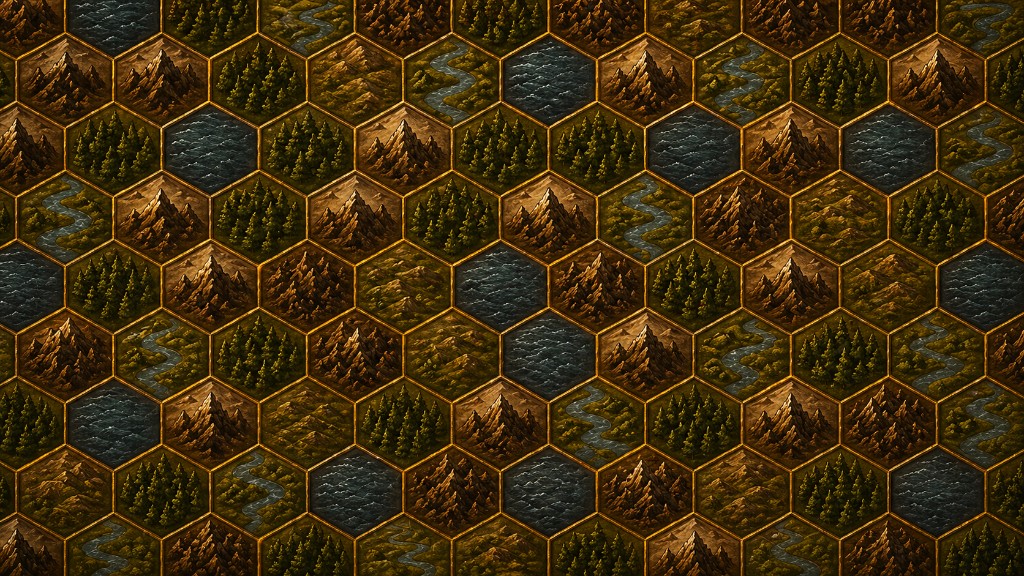
| Hex orientation | Pointy-top (Hexus default) | Match your VTT scene to pointy-top when importing UVTT or Foundry bundles. |
| Grid size (px per hex) | 140–280 px for table play; 200–320 px for VTT zoom | Use Export map presets; avoid upscaling a tiny PNG — re-export at target resolution. |
| PNG file size | < 8 MB per map layer when possible | Large maps: use Standard/High resolution tiers before Ultra for VTT upload limits. |
| Foundry import | Pro bundle + hexus-importer module | Prefer bundle over manual PNG when you need aligned grid + notes payload. |
Common misalignment fixes
- Grid rotated or offset: confirm pointy-top in both Hexus export and VTT scene. Re-import UVTT instead of scaling a mis-sized PNG.
- Map looks stretched: disable non-uniform resize in the VTT — use Alt/option constrained resize or re-export at the VTT’s native grid size.
- Hex centers drift at map edges: align using the map bounding box center, not a corner landmark; Foundry bundle import handles this automatically.
- Art differs from editor: VTT flat render skips some WebGL effects — compare against PNG export for ground truth.
Need more detail? Re-read the defaults and fixes above, or ask via beta feedback with your VTT name and export format.